Artificial intelligence is moving from experimentation into everyday business operations. Companies are using AI to automate repetitive work, improve customer experiences, analyze information, and support faster decision-making.
Two terms often appear in the same conversation: AI automation and AI agents. Although they are related, they are not the same thing. Choosing the wrong approach can lead to unnecessary complexity, higher costs, or a solution that does not fit the actual business problem.
This guide explains the difference between AI agents and AI automation, where each approach works best, and how to decide which one your business needs.
What Is AI Automation?
AI automation uses artificial intelligence to improve or automate a defined business workflow. A workflow usually has a known trigger, a sequence of steps, and an expected outcome.
For example, when a customer submits a support request, an AI-powered workflow can classify the request, extract important information, route it to the right team, create a ticket, and send an acknowledgement.
Traditional automation follows predefined rules. AI automation adds capabilities such as natural language understanding, document extraction, classification, prediction, and content generation. The process is still generally designed around a structured workflow, but AI helps the workflow handle more complex or unstructured information.
What Is an AI Agent?
An AI agent is a software system that can work toward a goal by interpreting information, deciding what action to take, using available tools, and evaluating the results.
For example, an AI sales agent could receive the goal of qualifying an inbound lead. It may review the lead’s message, search the CRM, identify missing information, ask follow-up questions, update records, and recommend the next best action.
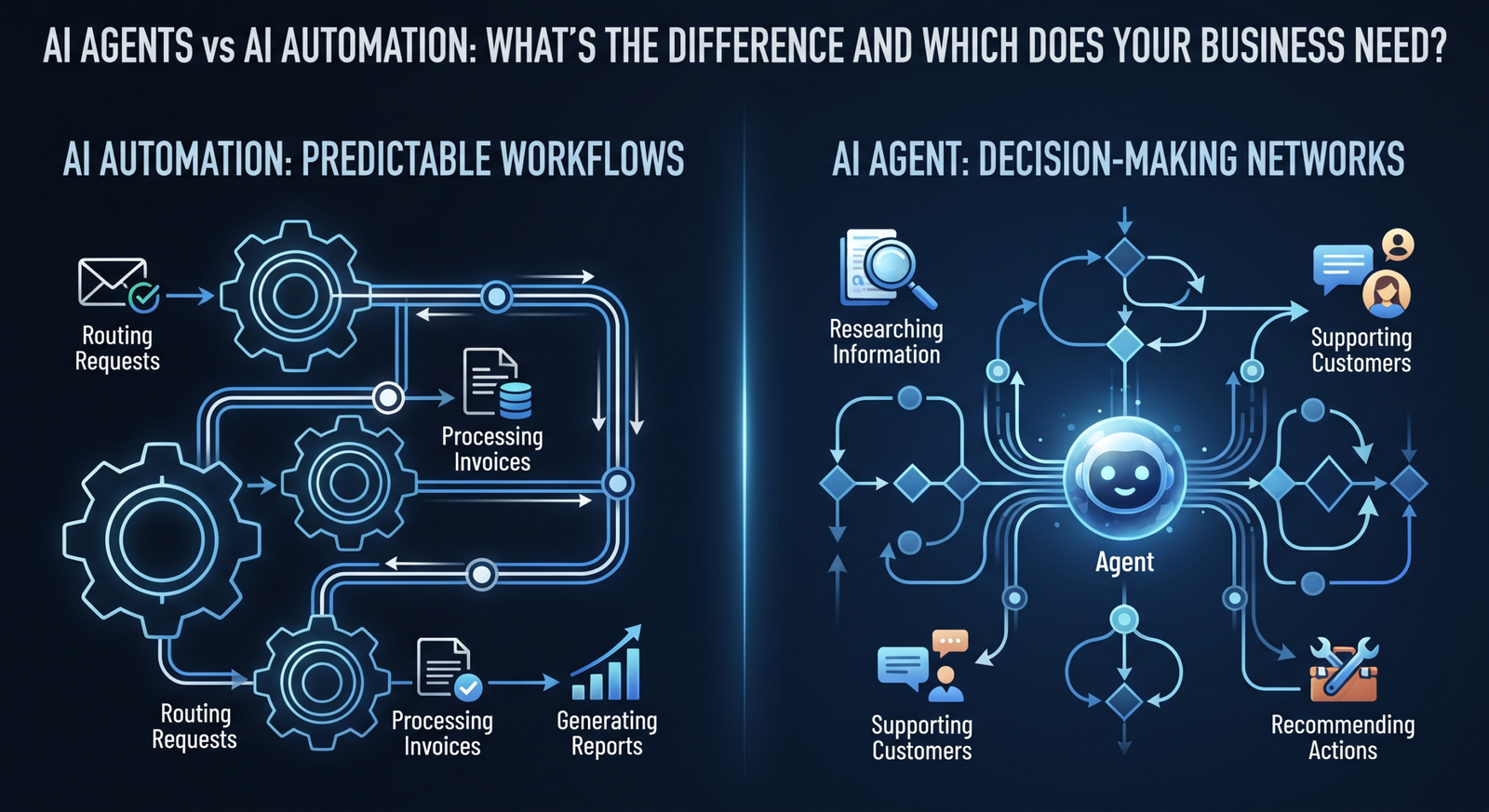
The important difference is that an agent is designed around goals and decision-making. It can select from available actions based on the situation rather than simply moving through one fixed sequence.
AI Agents vs AI Automation: The Core Differences
The easiest way to understand the difference is to compare workflow execution with goal-directed decision-making.
AI automation is usually best when the process is predictable. You know the trigger, the major steps, and the desired result. The AI component helps process language, documents, images, or data inside that workflow.
AI agents are more useful when the path to the result can vary. The system may need to gather information, choose between tools, respond to changing conditions, and decide what should happen next.
In practice, the strongest business systems often combine both. An AI agent may make decisions, while automation handles reliable downstream tasks such as creating records, sending notifications, or updating databases.
When Should Your Business Use AI Automation?
AI automation is usually a strong choice when you have high-volume, repetitive processes with relatively clear rules.
Common examples include:
- Processing invoices and business documents
- Classifying and routing customer requests
- Generating recurring reports
- Updating CRM records
- Automating employee onboarding steps
- Sending personalized follow-ups
- Extracting information from forms and PDFs
The goal is consistency and speed. If employees repeatedly move information between systems or spend hours performing the same administrative sequence, AI automation may produce immediate value.
When Should Your Business Use an AI Agent?
Consider an AI agent when the work requires more interpretation and flexible decision-making.
Examples include:
- A customer support agent that investigates issues across multiple knowledge sources
- A sales agent that researches prospects and recommends outreach actions
- An operations agent that monitors exceptions and coordinates follow-up tasks
- A research agent that gathers, compares, and summarizes information
- An internal knowledge agent that helps employees find answers across company systems
Agents should still operate with clear boundaries, approved tools, security controls, and human escalation paths. More autonomy does not mean unlimited autonomy.
How to Choose the Right Approach
Start with the business process rather than the technology label. Ask five questions:
1. Is the process predictable, or does every case require different decisions?
2. Are the inputs structured, or do they include emails, documents, conversations, and other unstructured data?
3. Does the system need to choose between multiple actions?
4. What happens if the AI makes a mistake?
5. Can the expected value justify the complexity of an agent?
If the process is stable and repetitive, begin with AI automation. If the process requires reasoning across changing information and multiple possible actions, an AI agent may be a better fit.
A practical strategy is to automate the predictable parts first and introduce agent capabilities only where flexible decision-making creates measurable value.
The Business Value of Combining Both
Businesses do not always need to choose one or the other. A modern AI system can use an agent as the decision layer and automation as the execution layer.
For example, an agent could review a customer request and decide whether it requires technical support, billing assistance, or escalation. Once the decision is made, automated workflows can create tickets, notify teams, update the CRM, and schedule follow-ups.
This combination keeps routine operations reliable while using AI intelligence where it provides the most value.
Conclusion
AI automation and AI agents solve different problems. Automation is ideal for repeatable workflows that need speed, consistency, and intelligent handling of information. AI agents are better suited to goal-driven work that requires context, decisions, and flexible actions.
The best starting point is a clear assessment of your existing processes. Identify where teams lose time, where decisions become bottlenecks, and where better access to information could improve outcomes. From there, you can determine whether automation, an AI agent, or a combination of both is the right solution.
Xhylo helps businesses design and build practical AI systems, from intelligent workflow automation to custom AI agents integrated with existing business tools.