One of the first questions businesses ask when considering an AI project is simple: how much will it cost?
The honest answer is that custom AI development does not have one fixed price. A focused proof of concept and a production-grade enterprise AI platform are very different projects. Cost depends on the problem being solved, the systems involved, the quality of available data, security requirements, the level of AI autonomy, and the amount of engineering needed to deploy and maintain the solution.
This guide explains the major cost drivers and provides a practical framework for estimating a custom AI project in 2026.
What Does “Custom AI Development” Include?
Custom AI development can include AI strategy, discovery, data preparation, model selection, application development, workflow integration, evaluation, security, cloud infrastructure, monitoring, and ongoing improvement.
A simple AI prototype may require only a small team and a limited number of integrations. A production system may require backend engineers, AI engineers, data specialists, product design, DevOps, security review, and extensive testing.
Typical Project Cost Ranges
The following ranges are broad planning estimates, not fixed quotes. Actual pricing varies by region, team composition, technical requirements, and project scope.
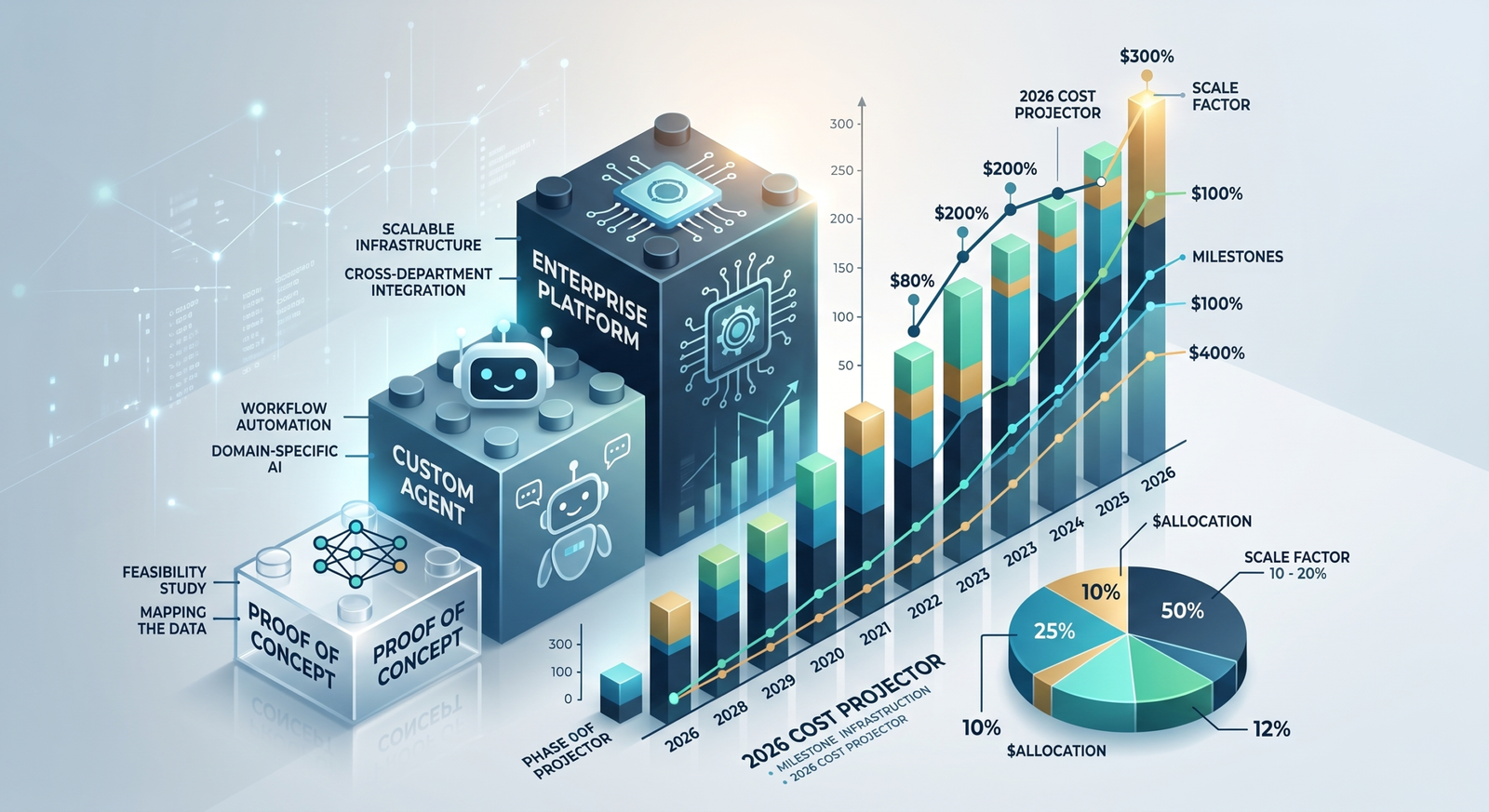
- AI proof of concept: approximately US$10,000 to US$40,000
- AI automation workflow: approximately US$20,000 to US$100,000
- Custom AI agent: approximately US$30,000 to US$150,000 or more
- Advanced machine learning solution: approximately US$75,000 to US$300,000 or more
- Enterprise AI platform: approximately US$150,000 to US$1 million or more
The purpose of these ranges is to show relative complexity. A detailed discovery phase is the best way to estimate a specific project.
1. Project Scope and Complexity
A system that summarizes documents is fundamentally different from a multi-agent platform connected to CRM, ERP, customer data, and internal tools.
Every additional workflow, user role, integration, language, data source, or deployment environment can increase engineering and testing requirements.
2. Data Readiness
AI projects often become expensive when the required data is incomplete, inconsistent, inaccessible, or poorly governed.
Costs may include data cleaning, labeling, migration, pipeline development, permission management, and quality checks. Understanding data readiness early can prevent unpleasant surprises later.
3. Integrations With Existing Systems
Many business AI projects must connect to existing software such as CRMs, ERPs, support platforms, document systems, payment services, or internal databases.
Integration work can be a major part of the budget, especially when systems have limited APIs, complex permissions, or legacy architecture.
4. Model and Infrastructure Costs
Some projects use third-party AI models through APIs. Others may require private deployment, specialized models, fine-tuning, or significant computing resources.
Operational costs can include model usage, cloud infrastructure, databases, storage, monitoring, and third-party services. These costs should be estimated separately from initial development.
5. Security and Compliance Requirements
A consumer prototype may have very different requirements from a system handling customer records, financial data, or confidential company information.
Authentication, access control, encryption, audit logging, data retention policies, security testing, and compliance work can increase the initial investment but may be essential for production deployment.
6. Testing and Evaluation
AI systems require testing beyond standard software quality assurance. Teams may need to evaluate factual accuracy, task completion, unsafe behavior, tool use, bias, hallucination patterns, and performance under unusual inputs.
A serious evaluation process adds cost, but it is also part of making an AI product dependable.
How to Budget More Effectively
The most effective approach is usually phased development.
Phase 1: Discovery and feasibility. Define the business problem, available data, users, success metrics, and technical risks.
Phase 2: Proof of concept or pilot. Build the smallest solution capable of testing the core assumption.
Phase 3: Production development. Add integrations, security, monitoring, user experience, and operational controls.
Phase 4: Scale and optimization. Expand successful workflows and improve performance based on real usage.
This reduces the risk of investing heavily before proving that the AI solution creates meaningful business value.
Questions to Ask Before Requesting a Quote
Before contacting an AI development company, prepare answers to these questions:
- What business problem are we solving?
- Who will use the system?
- What existing software must it connect to?
- What data is available?
- What level of accuracy or reliability is required?
- What actions can the AI perform?
- Are there security or compliance requirements?
- How will success be measured?
Clear answers lead to more realistic proposals and fewer surprises during development.
Conclusion
Custom AI development costs vary because the underlying projects vary dramatically. A focused pilot can often validate an idea with a modest budget, while enterprise-grade systems require greater investment in engineering, integrations, security, testing, and operations.
Instead of asking only, “What does AI cost?”, ask, “What business outcome are we trying to achieve, and what is the smallest reliable solution that can prove its value?”
Xhylo works with businesses to define AI opportunities, validate feasibility, and build custom AI solutions designed around practical business requirements.